Wet food can make daily feeding healthier and more appealing, especially for pets that need extra moisture. Yet it spoils faster than dry food, creating a real safety concern. The key question is, what is the safest way to automate wet food feeding? A reliable answer involves temperature control, measured portions, hygienic equipment, and regular supervision.
A suitable automatic feeder should keep food chilled or release it shortly before mealtime. Look for a secure lid, removable food trays, and clear manufacturer instructions. Ice packs may help, but they are not a complete refrigeration system. Wet food should not sit warm for long periods, particularly in a hot room. Small portions can reduce waste and limit exposure. A camera or simple check-in can confirm that the meal opened correctly and the pet actually ate.
Clean the tray after every feeding, even when it looks nearly spotless. Residue can hide beneath seals and corners. Wash removable parts with warm, soapy water, then dry them fully. Veterinary advice should guide portion size, feeding frequency, and special dietary needs. Pets with diabetes, kidney disease, allergies, or medication schedules may require closer monitoring.
Automation is helpful, not foolproof. Batteries fail. Lids jam. Pets ignore meals. A backup plan matters. Keep a second feeder or fresh food available, and inspect the system often. The safest routine is practical, consistent, and flexible. Convenience should never replace observation.
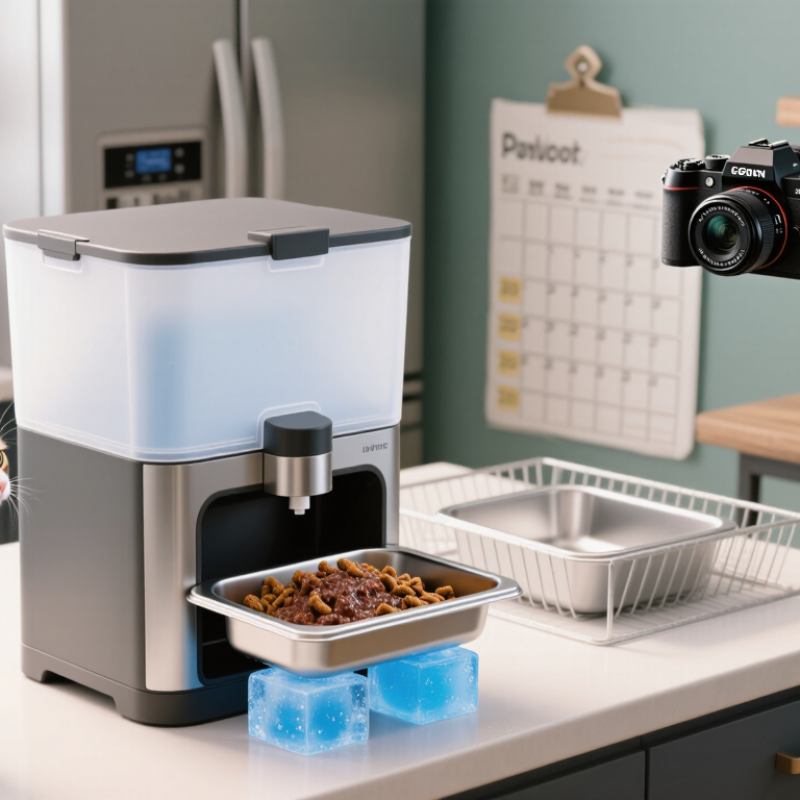
Wet food contains moisture, nutrients, and warmth that can support bacterial growth. At room temperature, safety changes faster than many caregivers expect. Using the FDA’s two-hour room-temperature limit as a conservative benchmark helps reduce this risk. If the room exceeds 90°F, the safer window may shrink to one hour.
Time matters. Odor cannot warn you reliably.
A safer automated routine uses small portions, timed delivery, and cooling between meals. A feeder with an insulated or chilled compartment can slow temperature rise. It should release only the amount an animal can finish promptly. Leftovers should be removed, not returned to the container.
Wash food-contact surfaces after each feeding, especially around the lid, tray, and drainage areas. These details matter more than a complicated schedule.
Automation reduces long periods of unattended exposure, but it does not replace inspection. Check the meal before serving. Look for unusual drying, separation, leakage, or contamination. A temperature sensor may help, though sensors can drift and batteries can fail. That weakness deserves attention.
I would also test the device during a normal day before relying on it overnight. Feeding plans can be technically clever and still fail when cleaning is forgotten, a pet eats slowly, or a power interruption leaves food sitting warm.
Wet food needs more than timed dispensing. Its storage chamber should hold portions at 40°F or below, matching the USDA refrigeration benchmark. This temperature slows bacterial growth while the feeder waits for the scheduled meal. A practical design uses a pre-chilled compartment, insulated walls, and a tight lid. Small portions cool more evenly than one large container. Keep them sealed.
A built-in temperature sensor adds useful protection. An alert should appear if the compartment rises above 40°F for too long. A separate refrigerator thermometer can verify that reading, because sensors can drift. Cold packs may help during short interruptions, but they are not a permanent solution. The food-contact tray also needs washing after each cycle. Residue hides in corners.
No system is foolproof.
Placement matters. Keep the feeder away from sunlight, ovens, radiators, and warm floors. Load only enough food for the planned schedule. USDA guidance also warns against leaving perishable food at room temperature for extended periods, especially beyond two hours. In real use, power failures and forgotten cleaning can defeat good engineering. My own weak point would be trusting an app without checking the actual food temperature. A simple daily inspection remains worthwhile: look for condensation, unusual odor, swollen containers, or a failed cooling cycle. If the food feels warm, discard it rather than guessing.
Cold-storage automation should keep wet food portions at or below the USDA refrigerator benchmark of 40°F (4°C). The chart compares key USDA food-storage temperature references.
USDA guidance identifies 40°F–140°F (4°C–60°C) as the food safety danger zone. Keeping automated wet-food portions at 40°F or colder helps limit time in this range, while 0°F (-18°C) is the recommended freezer temperature.
Timed dispensing is safer when it controls exposure, not just feeding time. Wet food can spoil quickly after opening, especially in a warm kitchen. The FDA advises refrigerating unused or leftover canned and pouched pet food promptly. It also follows the common two-hour limit for perishable food at room temperature, or one hour above 90°F.
That makes a timed dispenser useful when meals leave the refrigerator shortly before feeding. Prepare small portions in clean containers, then schedule release close to the pet’s normal mealtime. Avoid filling the device with a full day’s food unless it provides reliable chilling. A cool room helps, but it does not replace temperature control. Keep the feeding surface clean, too.
There is no universal FDA timer for every wet-food recipe. Ingredients, room temperature, portion size, and handling habits all matter. I would set a conservative window and discard food that looks dry, smells unusual, or has sat out too long. Do not rely on appearance alone. Some harmful bacterial growth shows no obvious warning.
In practice, the safest routine may feel wasteful: smaller portions, faster serving, and prompt cleaning. That inconvenience is worth examining, because automation can create false confidence.
A timer manages access. It does not make unsafe storage safe.
Why Is the Safest Way to Automate Wet Food Feeding? Portion control is the practical answer. Wet food is easy to over-serve, especially when a pet looks hungry. A measured feeder can divide daily calories into consistent meals, while reducing guesswork.
AAFCO feeding guidance should be the starting point, not a rigid prescription. Check the food’s nutritional adequacy statement, then read its weight- and life-stage directions carefully. A growing kitten, adult cat, and senior dog may need very different calorie amounts. The Association for Pet Obesity Prevention reported that 59% of dogs and 61% of cats were overweight or obese in its 2022 survey. Small errors matter. Ten extra grams each day can become visible weight gain over several weeks.
Use a kitchen scale when loading each compartment. Record the pet’s body weight every two weeks, and ask a veterinarian to assess body condition. AAHA nutrition guidance supports individualized calorie planning rather than relying on package estimates alone. Keep wet food chilled, and avoid leaving it at room temperature for extended periods, consistent with FDA pet-food safety guidance. The first setting may be wrong. Appetite, activity, medication, and illness can change needs quickly. Automation should create a review habit, not replace observation. A missed adjustment is still a human problem.
| Pet Profile | Starting Energy Estimate | Portion-Control Formula | Illustrative Wet-Food Portion | Suggested Feeding Pattern | Safety and Adjustment Guidance |
|---|---|---|---|---|---|
| Adult dog, neutered | Approximately 1.6 × RER | RER = 70 × body weight (kg)0.75 Daily kcal = RER × 1.6 |
For a 10 kg dog: RER ≈ 394 kcal/day Starting target ≈ 630 kcal/day At 100 kcal/100 g wet food: approximately 630 g/day |
Divide the daily amount into 2 meals. An automatic feeder can dispense equal portions at consistent times. | Use the food label's calorie statement and complete-and-balanced adequacy claim. Recheck body weight and body condition regularly. |
| Adult dog, intact or highly active | Approximately 1.8 × RER | Daily kcal = RER × 1.8 | For a 10 kg dog: Starting target ≈ 710 kcal/day At 100 kcal/100 g wet food: approximately 710 g/day |
Feed 2 or more meals when practical, especially if the dog eats quickly or has a large daily requirement. | Activity, reproductive status, climate, and health can change energy needs. Do not increase portions solely because the pet appears hungry. |
| Adult cat, neutered | Approximately 1.2–1.4 × RER | RER = 70 × body weight (kg)0.75 Daily kcal = RER × 1.2–1.4 |
For a 4 kg cat: RER ≈ 198 kcal/day Starting target ≈ 240–280 kcal/day At 100 kcal/100 g wet food: approximately 240–280 g/day |
Offer 2–4 measured meals. Smaller scheduled servings can support controlled intake and reduce rapid eating. | Indoor cats may need less energy than active cats. Monitor body condition rather than relying on a fixed can or pouch count. |
| Adult cat, intact or highly active | Approximately 1.4–1.8 × RER | Daily kcal = RER × 1.4–1.8 | For a 4 kg cat: Starting target ≈ 280–360 kcal/day At 100 kcal/100 g wet food: approximately 280–360 g/day |
Divide the daily allowance into several scheduled meals to match normal feline eating behavior. | Adjust gradually according to weight, body condition, activity, and veterinary advice. Ensure fresh drinking water is always available. |
| Puppy younger than 4 months | Approximately 3.0 × RER | Daily kcal = RER × 3.0 | For a 5 kg puppy: RER ≈ 234 kcal/day Starting target ≈ 700 kcal/day At 100 kcal/100 g wet food: approximately 700 g/day |
Feed 3–4 measured meals per day using food formulated for growth or all life stages. | Growth diets must meet the appropriate AAFCO nutritional profile or feeding-trial standard. Portion changes should be supervised by a veterinarian. |
| Puppy older than 4 months | Approximately 2.0 × RER | Daily kcal = RER × 2.0 | For a 10 kg puppy: RER ≈ 394 kcal/day Starting target ≈ 790 kcal/day At 100 kcal/100 g wet food: approximately 790 g/day |
Feed 2–3 measured meals and update the target as body weight and growth stage change. | Large-breed puppies have specific mineral and energy considerations. Select a suitable growth statement and obtain veterinary guidance. |
| Kitten younger than 4 months | Approximately 2.5 × RER | Daily kcal = RER × 2.5 | For a 2 kg kitten: RER ≈ 118 kcal/day Starting target ≈ 295 kcal/day At 100 kcal/100 g wet food: approximately 295 g/day |
Feed 3–5 small meals per day using a kitten or all-life-stages formula. | Rapidly growing kittens require carefully balanced nutrition. Weigh the kitten frequently and seek veterinary advice if appetite or growth is abnormal. |
| Kitten aged 4–12 months | Approximately 2.0 × RER | Daily kcal = RER × 2.0 | For a 3 kg kitten: RER ≈ 160 kcal/day Starting target ≈ 320 kcal/day At 100 kcal/100 g wet food: approximately 320 g/day |
Feed 2–4 measured meals and transition portions as growth slows and the kitten approaches adult size. | Use the label's life-stage statement and calorie content. Do not substitute adult-maintenance food without professional advice. |
| Overweight adult dog or cat | Often calculated from ideal body weight, not current weight | RER = 70 × ideal weight (kg)0.75 Weight-loss plans require veterinary supervision |
Calculate portions from the chosen food's kcal per gram or kcal per can. Avoid making an abrupt, severe calorie reduction. | Use fixed meal times and weigh every portion. Avoid unrestricted access to wet food in an automated feeder. | Safe weight loss depends on species, health, and starting condition. A veterinarian should set the calorie target and monitor progress. |
| Senior adult dog or cat | No single senior multiplier applies to every pet | Begin with adult maintenance needs, then adjust using body condition, activity, and health status | Measure the exact daily kcal target from the label rather than assuming a smaller serving is always appropriate. | Offer consistent meals, especially when medication, dental comfort, or appetite changes are involved. | Senior pets may have kidney, dental, thyroid, or mobility conditions that require a therapeutic diet or individualized feeding plan. |
| How to use this table: AAFCO establishes nutrient profiles and provides standards for nutritional adequacy statements; it does not prescribe one universal portion for every pet. Always check the food label for kcal per can, pouch, or kilogram and confirm that the product is complete and balanced for the pet's life stage. To calculate wet-food weight, use: daily grams = daily kcal target ÷ kcal per gram. Example: food containing 100 kcal per 100 g provides 1 kcal per gram. Adjust portions gradually based on body weight and body-condition changes, and consult a veterinarian for growing pets, weight-loss plans, pregnancy, illness, or unexpected appetite changes. | |||||
Wet food creates a warm, moist film inside bowls, dispensing chutes, and seals. That film can support bacterial growth when residue remains between feeding cycles. The U.S. Food and Drug Administration advises refrigerating unused wet pet food promptly and discarding leftovers exposed at room temperature. The USDA Food Safety and Inspection Service also uses a two-hour limit for perishable foods at room temperature. These figures offer a useful safety benchmark, although pet-feeding conditions can vary.
A safer automated routine removes every food-contact part after each cycle. Wash the bowl, nozzle, scraper, and gasket with hot water and detergent. Rinse away visible grease. Then sanitize according to the equipment maker’s instructions and allow each part to dry fully. The FDA Food Code 2022 emphasizes cleanable surfaces and regular cleaning where food touches equipment. In practice, I have found that hidden moisture beneath silicone seals causes trouble first. A quick visual check is helpful, but it is not enough. Small cracks deserve replacement, even when the device still operates normally.
Tips: Keep a spare clean bowl ready. Label refrigerated portions with the preparation time. Never refill fresh food over old residue. Check corners with a white paper towel. If an odor remains after washing, stop using that part and inspect it carefully. Automation reduces handling, but it does not replace sanitation judgment.
Use two hours as a conservative limit. Above 90°F, reduce the window to one hour. Time matters more than smell.
Release small portions shortly before normal mealtimes. Use reliable chilling between meals. Remove leftovers promptly.
Keep it at 40°F or below. Insulated walls, a tight lid, and pre-chilled portions help. Smaller portions cool more evenly.
No. A timer controls access, not temperature. Food can still spoil inside a warm compartment.
Remove it after feeding. Do not return it to the storage container. Wash the tray and lid afterward.
Check for drying, separation, leakage, condensation, or contamination. If the food feels warm, discard it rather than guessing.
No. Sensors can drift, batteries can fail, and alerts may be missed. Compare readings with a separate refrigerator thermometer.
Keep it away from sunlight, ovens, radiators, and warm floors. A shaded, cool location reduces temperature rise.
Power failures, forgotten cleaning, slow eating, and failed cooling cycles can create problems. I might trust an app too much. That deserves reflection.
Yes. Test it during a normal day first. Confirm dispensing, cooling, alerts, and cleanup before leaving food unattended.
The safest way to automate wet food feeding is to control time, temperature, portions, and cleanliness at every stage. Because wet food can become unsafe after sitting at room temperature for about two hours, an automated system should keep unused portions chilled near the recommended 40°F refrigeration benchmark. It should then release only the scheduled serving and limit its exposure to room temperature, reducing spoilage risks while helping pets receive meals consistently.
Portion sizes should reflect the pet’s age, weight, activity level, and feeding guidance rather than relying on a fixed amount for every animal. A reliable routine also includes removing uneaten food promptly and washing all food-contact components after each feeding cycle. Combining cold storage, timed dispensing, measured portions, and regular sanitation creates a practical feeding process that supports food safety and responsible pet care.

Purr Pet